
Why has there been so much focus on Greenland’s minerals and raw materials lately?
Recently, Greenland has become a prominent topic in political debates, media coverage, and strategic discussions extending well beyond the Arctic. High-level politicians, including former US president Donald Trump, have made statements that attracted international attention and sparked important questions about sovereignty, security, and global stakeholdings in the region. European governments responded notably, affirming that Greenland belongs to its people and that decisions about its future are exclusively for Greenland and Denmark to make. These reactions exceeded mere diplomacy, highlighting Greenland’s rising importance within a wider geopolitical context shaped by security concerns, NATO partnerships, and the escalating rivalry among world powers in the Arctic. Additionally, political focus has coincided with a rising interest in Greenland’s mineral and raw material resources. Discussions surrounding rare earth elements, critical metals, and energy resources are more common, often connected to supply security, technological progress, and economic independence.
This blend of geopolitics and resource interest prompts the question: why is Greenland drawing so much attention now? To answer, one must look beyond headlines and consider geography, history, raw materials, environmental factors, and global trends collectively.
Greenland at a glance
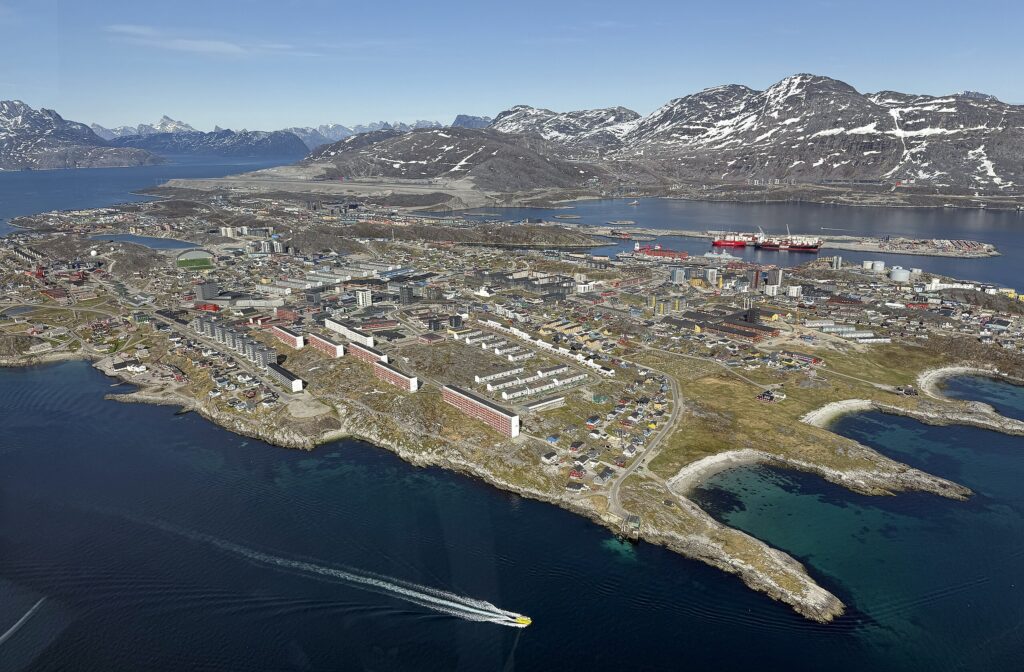
Source: Aerial view of downtown Nuuk, Greenland. Viewed from an Air Greenland helicopter – Quintin Soloviev
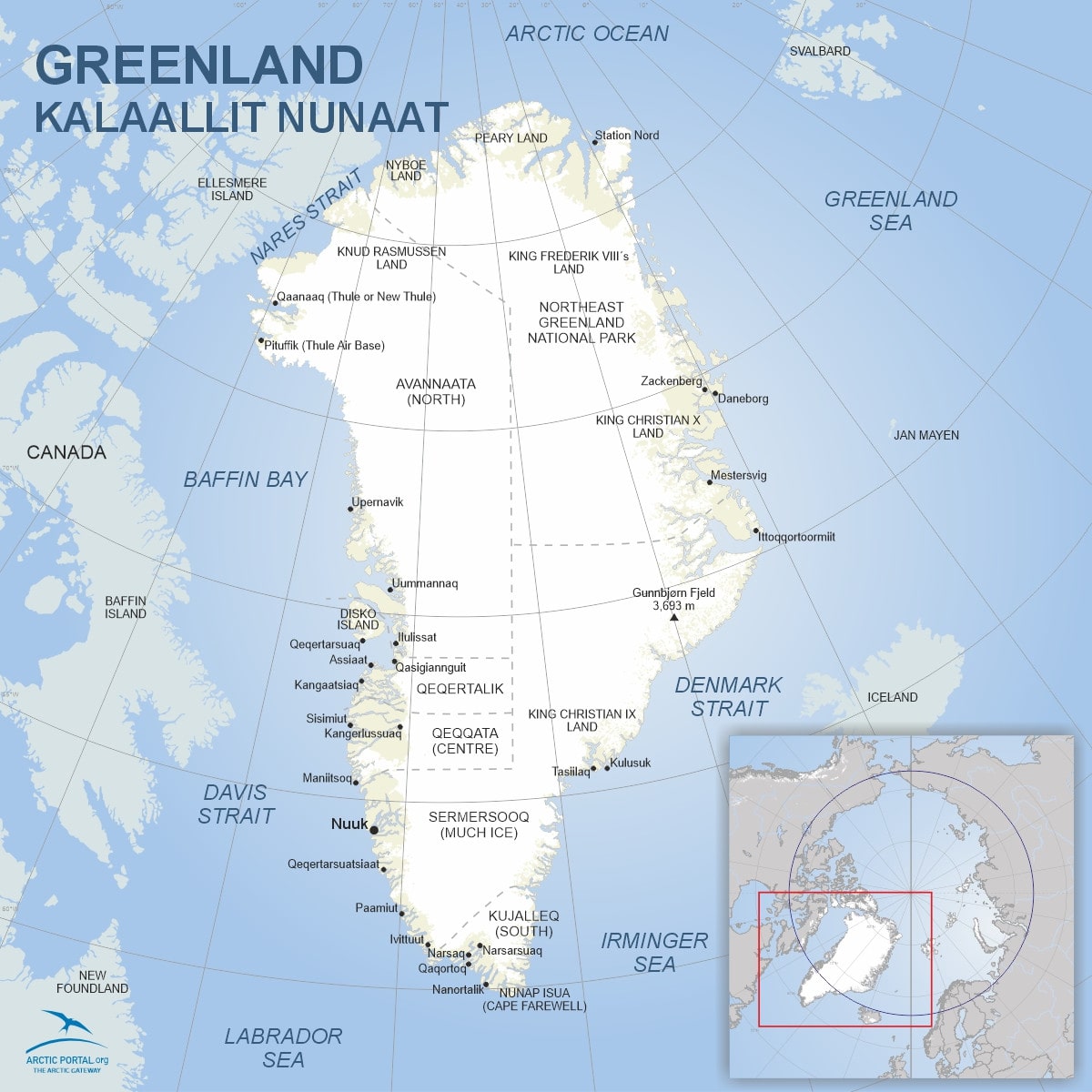
Greenland is the world’s largest island, with an area of about 2.2 million square kilometers, yet it has fewer than 60,000 residents. Most settlements are situated along the ice-free coast, while the interior is largely covered by the Greenland ice sheet, which heavily restricts infrastructure development and land-based economic activities.
It is a self-governing territory within the Kingdom of Denmark. Since gaining home rule in 1979 and expanding self-government in 2009, Greenland has assumed control over most domestic issues, including mineral resources and environmental policies. However, Denmark retains responsibility for defence and foreign affairs, integrating Greenland into European and transatlantic security frameworks.
Geographically, Greenland holds a strategic position in the Arctic, lying between North America and Europe. Its importance is less about proximity to Russia and more about its Arctic location, which has become an area of increased military activity and geopolitical focus. Developments involving Russia and China have heightened the importance of Arctic surveillance, early warning systems, and secure transportation routes, all amplifying Greenland’s strategic value.
Economically, Greenland’s economy is limited, with fisheries as the primary sector. Its public finances depend heavily on annual transfers from Denmark. Industrial activity and infrastructure are mostly confined to larger towns. This is significant because Greenland is not a mature mining region but a sparsely populated Arctic territory where large-scale development faces high logistical, environmental, and social challenges.
In summary, Greenland features a large landmass but a sparse population, along with significant political autonomy and harsh Arctic climate. Its importance globally is based on its geography, resource potential, and strategic location in the Arctic, rather than demographic or economic strength. As global focus on secure supply chains, critical raw materials, and Arctic security grows, Greenland’s significance rises not from its current output, but from its future possibilities.
What kind of minerals does Greenland actually have?
Greenland possesses abundant mineral resources, including rare earth elements, metals such as copper, zinc, and nickel, as well as industrial minerals like anorthosite and graphite, and gemstone deposits. Geological studies also suggest offshore fossil energy reserves. Yet, only a small fraction of these deposits have been thoroughly explored to determine their economic viability.
Greenland’s geological foundation is highly diverse, recording nearly four billion years of Earth’s history through various formations shaped by tectonic activity, magmatism, and sedimentation. This diversity accounts for the wide occurrence of metals, minerals, and gemstones across the island.
Much knowledge about Greenland’s geology comes from the Geological Survey of Denmark and Greenland, the official scientific body that maps geology, documents mineral deposits, and shares open data. It does not regulate or operate mining; decisions on mineral licensing and development are made by the Greenlandic government, Naalakkersuisut.
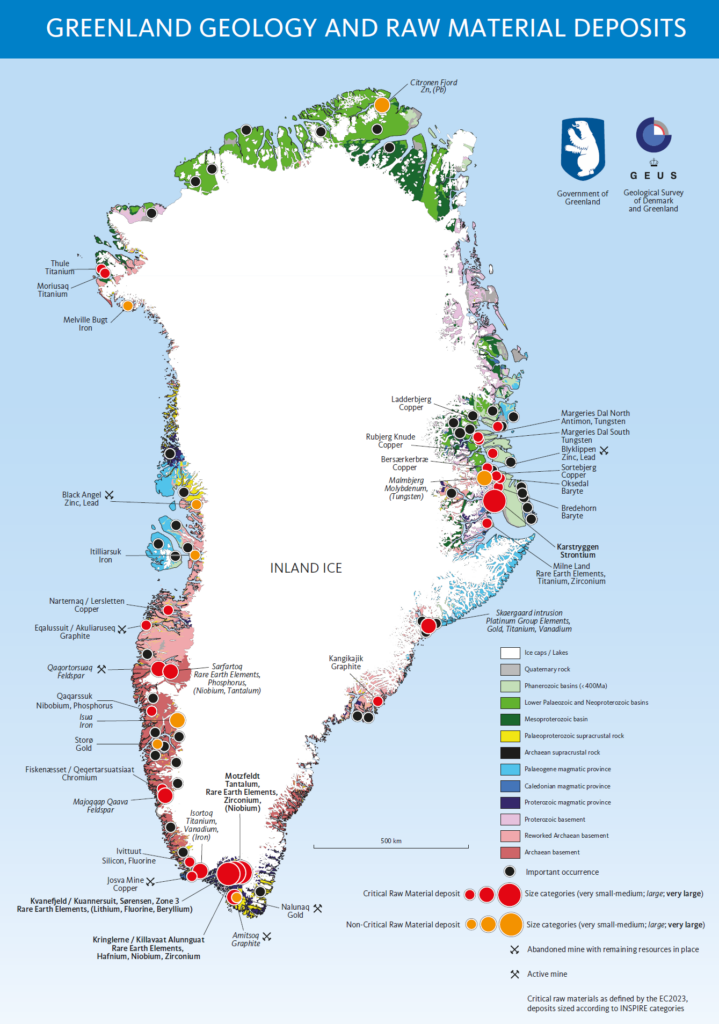
Source: Overview of where a selection of important and critical minerals and raw materials are found in Greenland – www.greenmin.gl/raw-materials-maps
It’s important to differentiate between known mineral occurrences and deposits that are economically viable. While Greenland contains many raw materials, very few are well enough explored to assess their size, quality, or feasibility. Most sites are still in early exploration stages.
A significant obstacle is ice cover. About 80% of Greenland is covered by ice sheets, preventing direct geological investigations in those areas. Although mineral deposits might extend beneath the ice, current methods can’t access them. Climate change is causing ice retreat, but it is unlikely to reveal large new exploration zones soon, though it could improve marine access as sea ice diminishes.
Recent attention has centred on critical raw materials which are essential for the economy and vulnerable to supply disruptions. Assessments show Greenland hosts many such materials, including rare earths and metals used in energy, electronics, and high-tech applications. However, their presence does not guarantee a secure supply, as feasibility, environmental factors, and economics are crucial.
Despite its geological promise, Greenland’s mining industry remains limited. As of early 2026, only two mines are operational: a gold mine in the south and an anorthosite mine near Kangerlussuaq in the west. This contrast between geological potential and industrial activity underscores Greenland’s status as a region of long-term promise rather than an established mineral supplier.
Why has global interest increased now?
Over the last decade, raw materials have evolved from a technical issue to a crucial strategic concern. Modern economies depend on an increasing number of minerals for renewable energy, electric vehicles, digital infrastructure, and advanced manufacturing. Many of these materials are hard to replace and require stable, predictable supplies.
To address this, the European Commission introduced the concept of critical raw materials- defined by their high importance to Europe’s economy and significant supply disruption risks. The EU updates this list regularly to reflect technological advances, market shifts, and geopolitical risks.
A key driver of concern is supply concentration, as global production and processing for many critical raw materials are dominated by few countries, creating vulnerabilities for dependent industries. Recent supply chain disruptions have heightened awareness of these risks.
Scientific assessments now help identify regions with long-term potential to reduce such dependencies. A comprehensive review by the Geological Survey of Denmark and Greenland shows Greenland hosts deposits of many EU-critical raw materials. The study notes that Greenland’s ice-free areas have geological environments favourable for a variety of critical materials, like rare earth elements, graphite, niobium, tantalum, lithium, and platinum group metals. However, this is a geological evaluation of potential, not an assessment of economic viability or immediate production. Greenland’s relevance lies not in its ability to quickly replace current suppliers but as a scientifically documented long-term diversification option. As the EU aims to enhance supply security through recycling, substitution, domestic production, and strategic partnerships, Greenland is increasingly part of strategic discussions.
Overall, global interest in Greenland reflects broader shifts in how raw materials are perceived and managed, rather than a sudden or isolated focus on the island.
Strategic and political relevance of Greenland
Greenland’s strategic importance mainly stems from its position in the Arctic, situated between North America and Europe. This location has historically been vital for transatlantic security, surveillance, and cooperation, long before minerals entered public discussions. As climate change and geopolitical shifts draw more attention to the Arctic, Greenland’s role within existing frameworks has become clearer.
Recently, economic security has gained prominence alongside traditional security concerns. Reliable access to key raw materials is now seen as a strategic issue, closely linked to industrial resilience, technological progress, and the energy transition. This has altered political perceptions of regions with geological potential.
In this context, the European Union and Greenland formalised their cooperation through a strategic partnership focused on sustainable raw materials value chains. This partnership benefits both parties: Greenland aims to diversify its economy within strict environmental and social standards, while the EU seeks to secure long-term, stable raw material supplies in a well-regulated environment.
The partnership does not prioritise rapid extraction or short-term supply. Instead, it stresses sustainability, infrastructure, skills development, research collaboration, and adherence to high environmental, social, and governance standards. This highlights an important point: Greenland’s relevance in raw materials discussions is less about immediate production and more about governance, long-term planning, and alignment with international standards.
Strategically, Greenland occupies a crucial position at the intersection of Arctic geopolitics, economic resilience, and sustainability policies. Its importance is driven not by urgency or volume but by its potential to influence the responsible and cooperative development of future raw material supply chains.
Conclusion
The increased attention on Greenland isn’t driven by a single political statement or sudden mineral discoveries. Instead, it reflects broader structural shifts in how raw materials, security, and sustainability are perceived globally. Greenland has a unique mix of characteristics: extensive territory, a well-documented and complex geology, political stability, high environmental standards, and a strategic Arctic location. These qualities explain why Greenland is now part of discussions on critical raw materials, even though mining is still limited and development is slow. It’s also important to distinguish potential from reality: possessing raw materials doesn’t guarantee extraction. Long-term factors like environmental protection, social acceptance, infrastructure, and governance are crucial. Current partnerships and policies emphasize responsible planning, research, and cooperation over immediate supply. Viewed this way, Greenland’s rising profile is part of a long-term shift towards resilience, diversification, and sustainability, not quick exploitation. Recognizing this helps move the conversation beyond headlines and toward a more balanced understanding of Greenland’s future role in raw material strategies.